Based off of their website design from the early days of the internet, I wasn't expecting the Museum of Jurassic Technology very grand entrance to an elaborate building.
 |
| I rang the doorbell even though there was an Open sign. People looked at me funny when I walked in. |
After you enter and realize you're in the giftshop, what's beyond are very dark hallways. No maps to be given out or exhibit/area lists - just several paths to move towards. Kind of poetic in a way, but it just freaked me out because I knew I'd be bumping into people (yes, it was actually pretty packed).
There was no picture-taking allowed to preserve the eerie darkness of the museum, so I'll be using sources off of the ancient website to provide images.
 |
| The aviary on the roof was my temporary respite from the overwhelming darkness. And even then, there was no exit from there besides going through the whole museum again. |
I have just realized that the exhibit of The Life and Works of Athanasius Kircher, a "master of a hundred arts," are all some other artists' recreations or models of Kirchers original etchings and ideas. I chose to look at the collection because they were represented through encased dioramas with no apparent subject besides scenery until one would look through a viewing apparatus that projected people into the scene as per Kircher's works.
 |
Why the Tower Could Not Reach the Moon
|
 |
| The World is Bound with Secret Knots Very simply: everything is connected. Ancient "butterfly effect" principle.http://www.mjt.org/exhibits/magnes.html |
 |
| The Conversion of St. Eustace at Mentorella He saw Jesus. He didn't make pagan sacrifices. He was burned alive inside a bull. Standard stuff. http://www.mjt.org/exhibits/eustace.html |
 |
| The Pyramids of Memphis and a Tomb A memento of Kircher's fascination with Egyptian culture. http://www.mjt.org/exhibits/hieroglyphs.html |
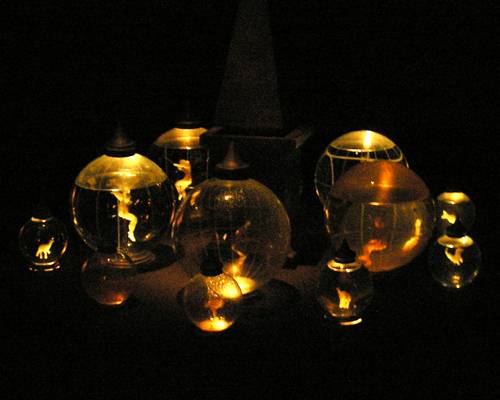 |
| A Magnetic Oracle - spelling out messages with magnetic hydromancy. http://www.runningwolfpack.com/potw2006.html |
Hagop Sandaldjian's The Eye of the Needle microminiature sculptures were examples of well-appreciated attempts at manipulating every aspect of our world. |
| Not at the nanoscopic level, yet a very low-tech attempt. http://www.mjt.org/exhibits/hagop/hagop2.html |
A set of microscopes rivaling the collection of a college learning laboratory displayed Henry Dalton's work with micrography and micromosaics.
A show of vectography, an early form of 3D presentation that reminded me of the collectible holographic trading cards from 90's days' past, utilized a set of lenses to project select parts of manipulated images at a viewer for vision diagnostic purposes; the technology was headed by the Polaroid company and Edwin H. Land.
 |
| Not nearly as exciting as Pokemon in motion, and definitely not as cheap - vectographs failed because their film was too expensive. http://freepages.history.rootsweb.ancestry.com/~dickbolt/Vectograph.html |
Albert G. Richard's Floral Stereoradiographs of multiple-angled x-ray images reminded me of our lectures on CAT scanning of our own brains and bodies and how our progression to that point was clearly spurred on by our appreciation of images like these.
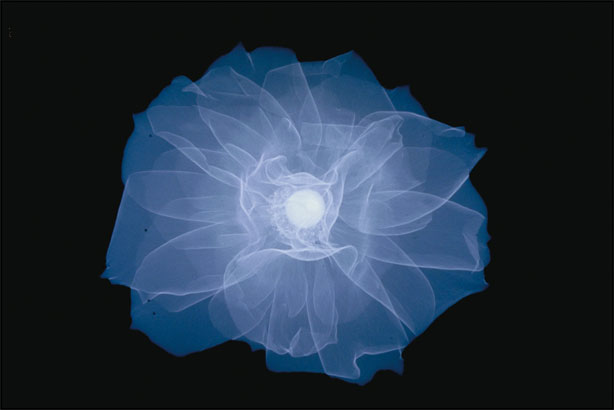 |
| You're not seeing the insides of the flower, but you're seeing it differently. This ability is a privilege that can only be expected to be abused to the point where everything you see is so different from what's normally possible, it's almost unrecognizable - and yet you know that it is the true representation of that object. http://www.mjt.org/exhibits/alRichards/richards2.html |
An exhibit wall was labeled No One May Ever Have The Same Knowledge Again and contained letters from a Dr. Hale he left for an observatory, and even though I didn't read the mass of text or see the diagrams on display, the title itself had a level of profoundness all on it's own. Once a fact is known or an opinion put forward, all previous knowledge has either become reinforced or subject to a paradigm shift - the context for the knowledge has been rendered different and in a new light.
Another hallway depicted Giacomo Torelli's intermezzi, mechanisms and methods of scenery and scene changes on theatrical stages. It was an interesting to see his goal as an artist to show not just one image to an audience but multiple images to accurately portray plays needed to apply simple technology to become efficient and enhance the theater experience.
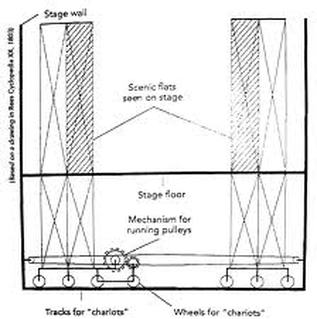 |
| http://italianrenaissancetheatre.weebly.com/giacomo-torelli.html |
Although this sequence is all digitally rendered, it's obviously based off of the on-stage mechanisms that transition from scene to scene.
Geoffrey Sonnabend's representation of short and long-term memory using geometric shapes intrigued me because it was not a conventional depiction - one is used to memory being explained abstractly as a form/indicator of consciousness by higher organisms or chemically by sense-neuronal interaction, but the Model of Obliscence is mentally engaging for assigning a physical explanation for memory.
 |
| This is how you forget things. Really. http://www.mjt.org/exhibits/delson/oblisci.html |
One section of the museum was dedicated to the works of Konstantin Tsiolkovsky and his contributions to the Russian space race and rocket technology. Not only is he greatly revered in Russia for his professional works, but he has worldwide recognition.
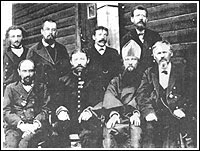 |
| His name may not be as recognizable as Einstein's, but he is another respected scientist all the same. http://www.russianspaceweb.com/tsiolkovsky_kaluga.html |
Tsiolkovsky was quoted by the museum to have said ""All the universe is full of the lives of perfect creatures." Based off of the accompanying exhibit of animals that participated in cosmic exploration, I took it to mean that their survival in the space missions was proof of the greatness of not just our own species, but of all organisms - we may desire to find another place for ourselves in the universe, but animals - maybe not even the ones that we have come to know - will be there right beside us.
 |
| Similarly, this project by the same name shows through superposition and facial expression-tracking mimicry how we can be represented by any one of these creatures. http://www.gravitytrap.com/artwork/perfect-creatures I would think that the section of the museum of traditional medical/superstitious cures such as the glass rod of health, fasting spittle, mouse diets, infant nails, and dog-rose gall was my favorite because it shows how much our medical knowledge and technology has progressed from relying on old-wives tales to save lives. Although they provide a chuckle here and there, it's kind of depressing how they were actually the methods and hopes of some generations to survival. The Museum of Jurassic Technology was a very different experience from your publicly-funded large-scale museums and art exhibits and definitely deserves a visit if you're in the area. |

GETTING OUT AND GETTING MY MCDONALD'S ICED TEA TIME
It wasn't disappointing, I knew there wouldn't be any.
The lovely lady pictured above asked if I'd like some tea, but she was so sweet I couldn't bear bothering her.
So I got my own sweet thing. For a dollar.
 |
| I made this. No need for a link for copyright. Well, I didn't make The Simpsons. |

No comments:
Post a Comment